Tool Search: 21st CCLC
The 21st Century Community Learning Centers (CCLCs) provide academic enrichment opportunities during non-school hours for children, especially those attending high-poverty, low-performing schools. This program helps students meet state and local student standards in core academic subjects and offers enrichment activities, literacy, and other educational services to families.
The information provided here explains how to record 21st-century information in Campus. Always follow your district's policies when adding or modifying 21st Century information.
Calendar information, attendance preferences, course information and Ed-Fi configuration need to be done prior to enrolling students into CCLC programs. See the 21st Century Setup Information section for guidance.
21st Century information is reported on the Student Program Association Ed-Fi Resource and the Student Program Attendance Events Resource. See the Arizona Ed-Fi article for more information.
CCLC Course information is reported on the 21st CCLC Summary of Classes Report.
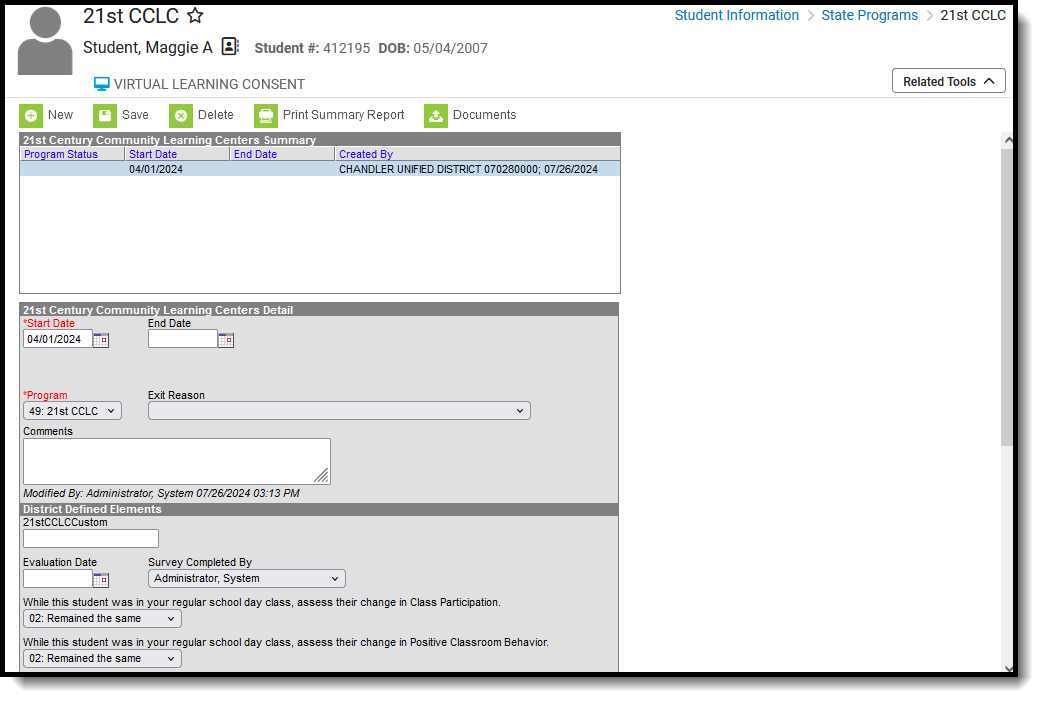 21st CCLC Record
21st Century Student Information
A student may participate in the 21st CCLC program sporadically throughout the year. Meaning, they might participate for a period of time in the summer, then again sometime in the school year. When this happens, individual enrollments AND 21st CCLC program records for each set of dates needs to be created.
A student who participates from July 1 to July 31, then again from September 1 to September 30, would have two enrollment records with start/end dates for June and start/end dates for September, and two CCLC records with the same start/end dates for June and September.
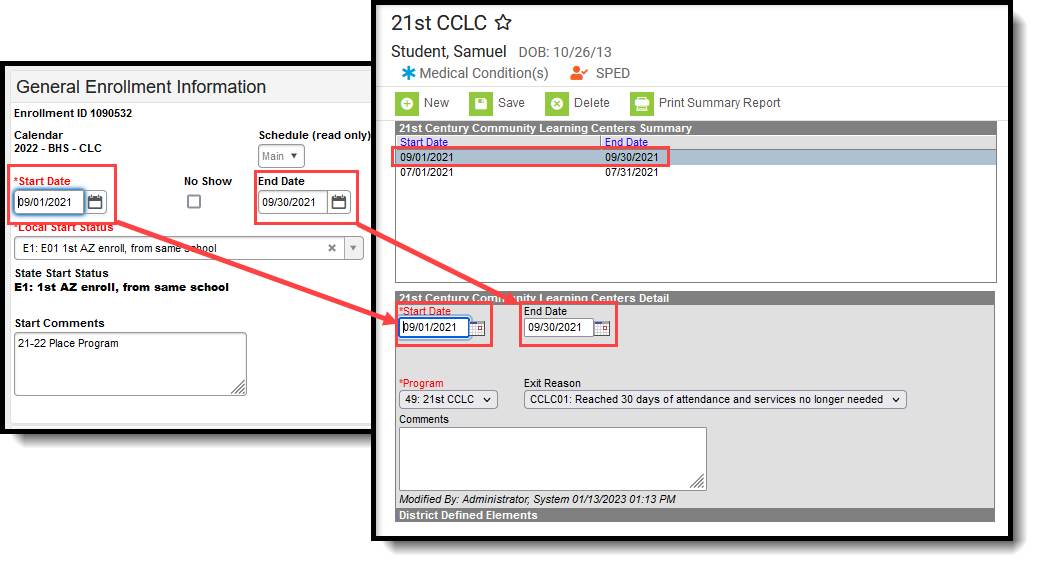
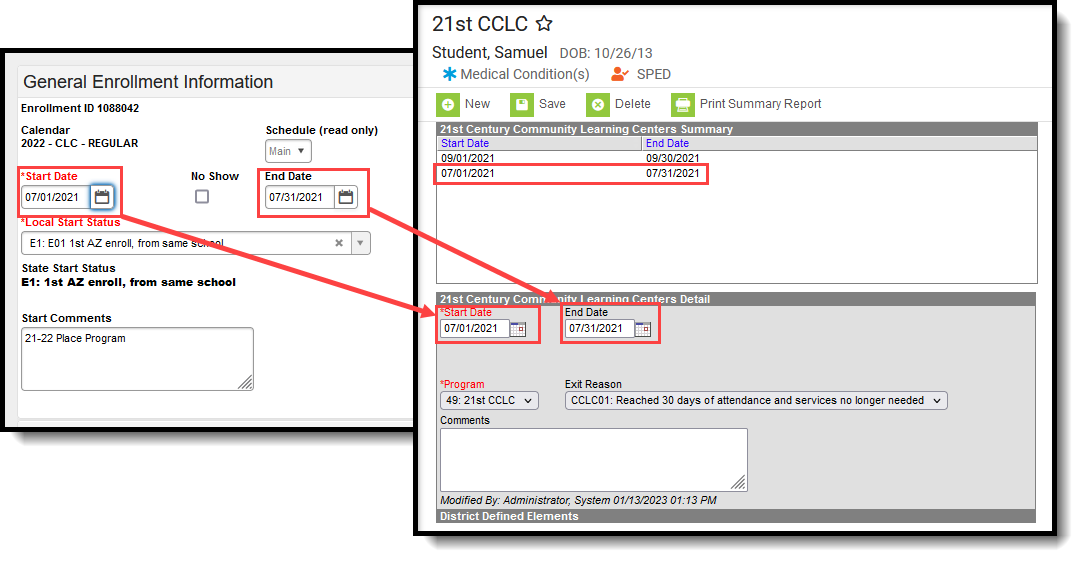
Add CCLC Enrollment
Tool Search: Enrollments
- Verify the 21st CCLC Calendar is selected in the toolbar.
- Click New to add a new enrollment. In the General Enrollment Information editor, enter at least the required information needed to save the enrollment:
- Calendar
- Schedule
- Grade Level
- Start Date
- Service Type
- Local Start Status
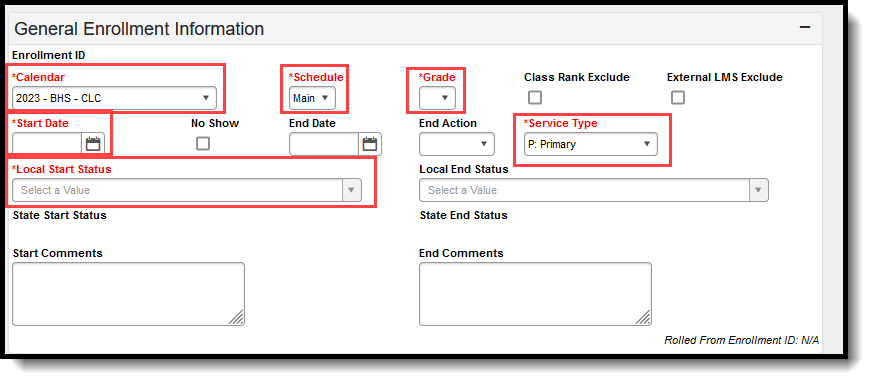 General Enrollment Fields for CCLC
- In the State Reporting Fields Editor:
- Set the Local Service Type to O: Program Only.
- Mark the State Exclude checkbox.
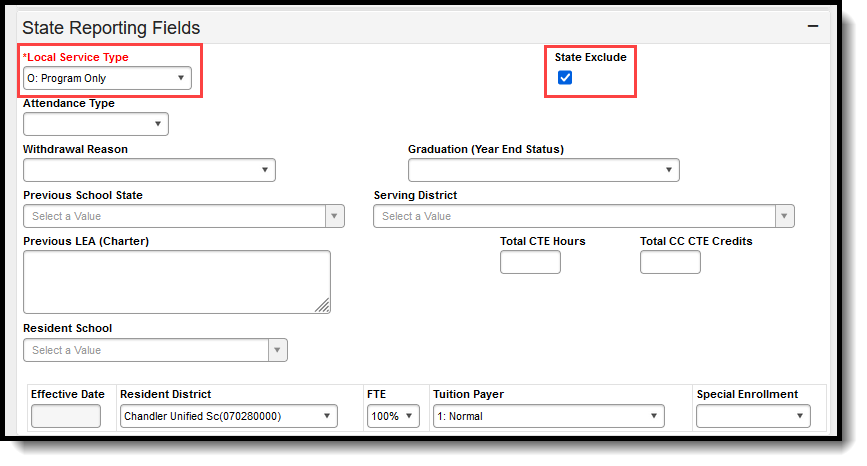 State Reporting Fields for CCLC
- Click Save.
Add CCLC Record for Student 21st CCLC
Tool Search: 21st CCLC
- Click New.
- Enter a Start Date - usually June 1 of the reporting year.
- Select the appropriate Program for this student.
- Enter any Comments needed for this record.
- Click Save when finished.
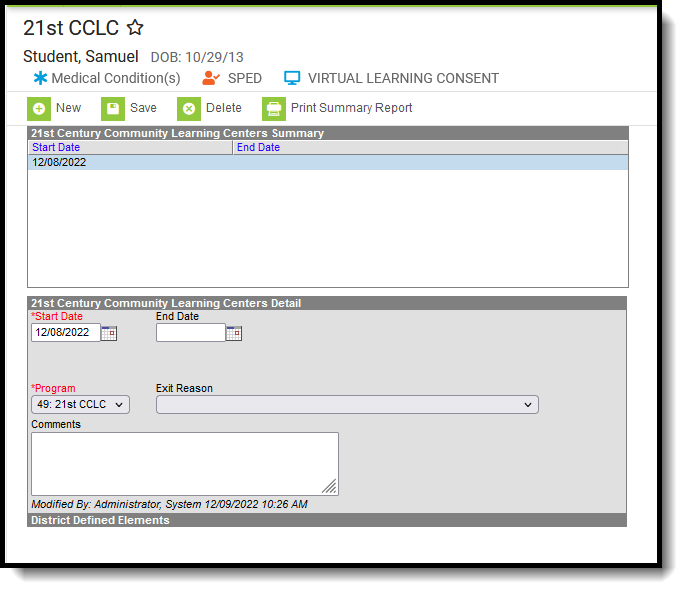 CCLC Record
While only the Start Date and Program fields are required, to ensure accurate and complete reporting, all fields need to be populated for students who participate in multiple CCLC programs throughout the year.
Schedule Student into CCLC Courses
Tool Search: Schedule
Once the enrollment record for the CCLC student is saved and a CCLC record is tied to that enrollment, the student can be scheduled into CCLC Courses. This can be done through the Walk-In Scheduler or through the Section Roster Setup.
Add Roster Start and End Dates
Tool Search: Schedule
Because CCLC courses are offered for a short period (usually a month), the Roster Start Date and Roster End Date must be populated when a student is scheduled into the course.
Once the course is added to the student's schedule, select that course from the Schedule grid. Enter the Start Date and End Date of the course.
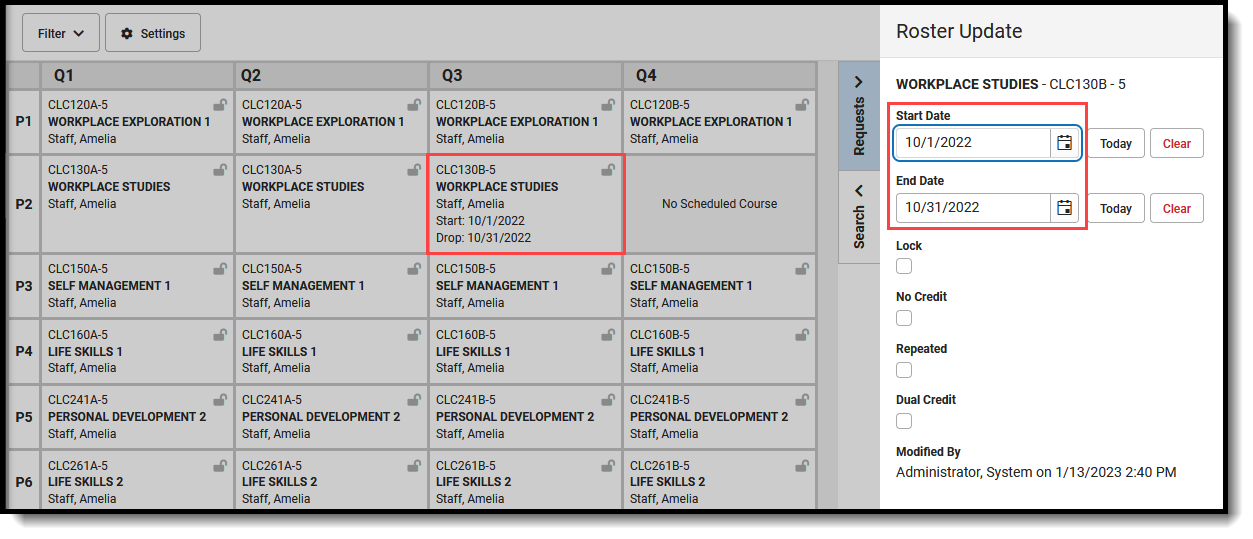 Roster Dates Added for CCLC Course
End CCLC Record for Student
Tool Search: 21st CCLC
- Select the 21st CCLC record that needs to be ended. The 21st Century Community Learning Centers Detail editor displays.
- Enter an EndDate for this student that is the last day they are receiving services.
- Enter an Exit Reason for the student.
- Enter any Comments related to the ending of this student receiving services.
- Enter the student's Evaluation Date.
- Verify your name is selected in the Survey Completed By field.
- Answer the three survey questions listed with one of the provided answers.
- Click Save when finished.
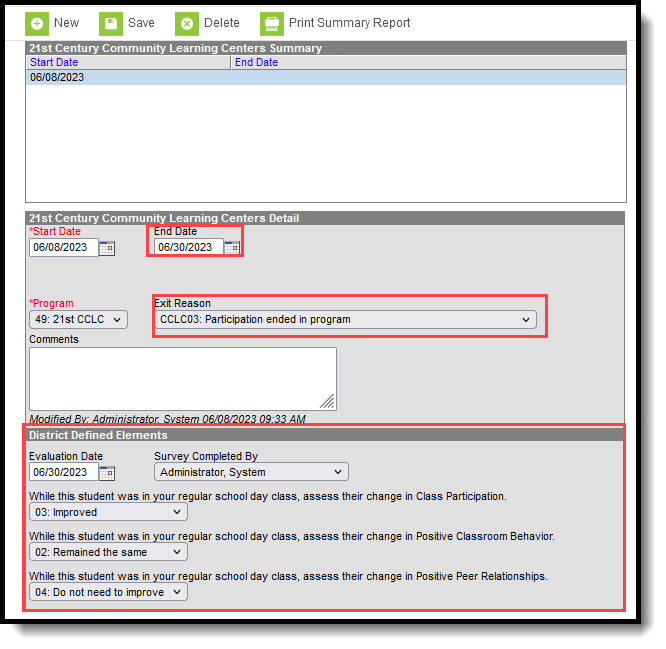 Ending a CCLC Record
21st CCLC Field Descriptions
See the Arizona Ed-Fi article for resource information for all resources listed below.
| Field | Description | Location | Resources |
|---|---|---|---|
| Start Date | Indicates the date the CCLC record began.
|
Database Location: TwentyFirstCCLC.startDate
Ad hoc Inquiries: Student > Learner > State Programs > TwentyFirstCCLC > twentyFirstCCLC.startDate |
Student Program Associations
Student Program Attendance Events |
| End Date | Indicates the date the CCLC record ended. |
Database Location: TwentyFirstCCLC.endDate
Ad hoc Inquiries: Student > Learner > State Programs > TwentyFirstCCLC > twentyFirstCCLC.endDate |
Student Program Associations
Student Program Attendance Events |
| Program | Lists the CCLC Program in which the student participated. |
Database Location: TwentyFirstCCLC.program
Ad hoc Inquiries: Student > Learner > State Programs > TwentyFirstCCLC > twentyFirstCCLC.program |
Student Program Associations
Student Program Attendance Events |
| Exit Reason | Lists the reason the student exited the CCLC Program.
|
Database Location: TwentyFirstCCLC.exitReason
Ad hoc Inquiries: Student > Learner > State Programs > TwentyFirstCCLC > twentyFirstCCLC.exitReason |
Student Program Associations
Student Program Attendance Events |
| Comments | Provides additional information on the CCLC record. |
Database Location: TwentyFirstCCLC.comments
Ad hoc Inquiries: Student > Learner > State Programs > TwentyFirstCCLC > twentyFirstCCLC.comments |
Student Program Associations
Student Program Attendance Events |
| Evaluation Date | Date of when the student evaluation was observed. |
Database Location: TwentyFirstCCLC.evaluationDate
Ad hoc Inquiries: Student > Learner > State Programs > TwentyFirstCCLC > twentyFirstCCLC.evaluationDate |
N/A |
| Survey Completed By | Indicates which staff person performed the student evaluation. This lists all active staff in the selected school. |
Database Location: N/A
Ad hoc Inquiries: Student > Learner > State Programs > TwentyFirstCCLC > twentyFirstCCLC.staffPersonID |
N/A |
| Class Participation | Requests an evaluation of the student for their level of class participation for the statement "While this student was in your regular school day class, assess their change in Class Participation."
Answers are limited to one of the following:
|
Database Location: TwentyFirstCCLC. classParticipation
Ad hoc Inquiries: Student > Learner > State Programs > TwentyFirstCCLC > twentyFirstCCLC. classParticipation |
N/A |
| Positive Classroom Behavior |
Requests an evaluation of the student's level of class participation for the statement: "While this student was in your regular school day class, assess their change in Positive Peer Relationships." Answers are limited to one of the following:
|
Database Location: TwentyFirstCCLC.positive ClassroomBehavior
Ad hoc Inquiries: Student > Learner > State Programs > TwentyFirstCCLC > twentyFirstCCLC.positive ClassroomBehavior |
N/A |
| Positive Peer Relationship |
Requests an evaluation of the student for their level of class participation for the statement "While this student was in your regular school day class, assess their change in Positive Peer Relationships." Answers are limited to one of the following:
|
Database Location: TwentyFirstCCLC.positive PeerRelationships
Ad hoc Inquiries: Student > Learner > State Programs > TwentyFirstCCLC > twentyFirstCCLC.positive PeerRelationships |
N/A |
21st Century Setup Information
This process requires a one-time setup per school year.
Calendar Creation
Tool Search: Calendar Information
Create a separate calendar for 21st CCLC students. Use the Calendar Wizard to roll calendar information forward from the current year to the next year.
- Enter a Start Date of June 1 (06/01/20XX) of the reporting school year. For the 23-24 school year, the start year is 2023; for the 24-25 school year, the start year is 2024. When 21st CCLC courses start in May, enter the first day in May that the state accepts data as the Start Date, which is May 23, 20XX.
- Enter an End Date of May 30 (05/30/20XX) of the reporting school year. For the 23-24 school year, the end year is 2024; for the 24-25 school year, the end year is 2025. The Month and Day of the End Date must be ONE DAY PRIOR to the Start Date - calendars cannot be more than 365 days; for a start date of May 23, the end date would be May 22.
- Set the Attendance Type to 017:Positive.
- Leave the Days Per Week field blank to ensure this calendar does not send information to the state.
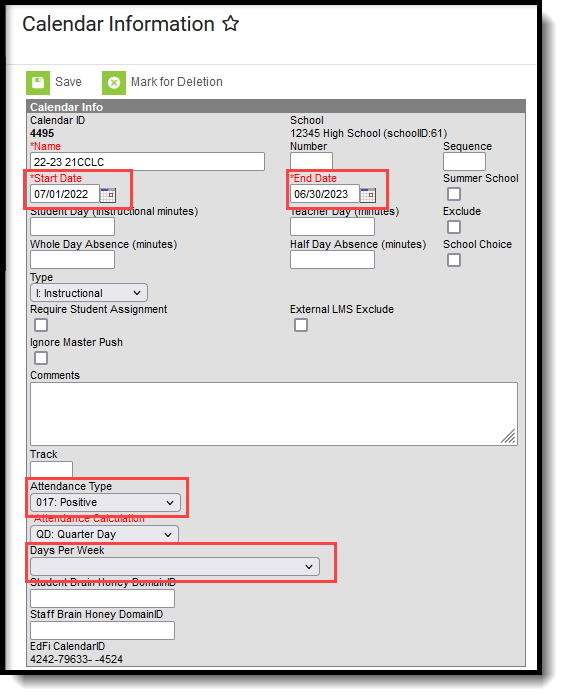 21st Century Calendar Dates
Set the Calendar Terms, Periods and Days as you would for any other calendar. Ensure that the days where attendance is recorded are marked as Attendance AND Instructional days, even during the summer months.
School Year History
Tool Search: School Information
To identify the school as a 21st CCLC learning center, mark the 21st CCLC checkbox on the School History record.
In order to report discipline events for students at a 21st CCLC school, regardless of whether the student participates in a 21st CCLC program, this checkbox must be marked.
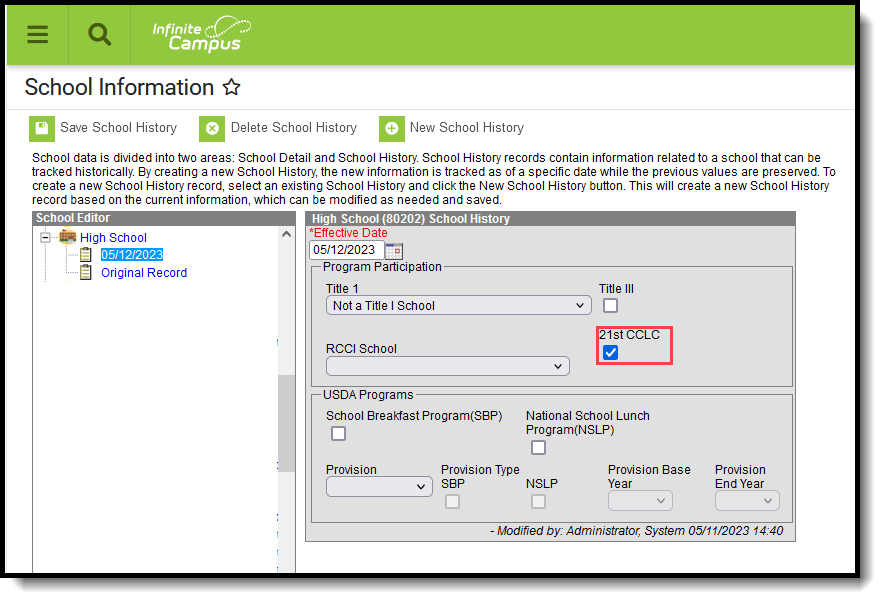 21st CCLC checkbox on School History Record
Positive Attendance Preferences
Tool Search: Positive Attendance Preferences
Attendance is sent for 21st CCLC Programs as Positive Attendance. To send this information correctly, districts need to enter attendance events for EACH day and time a student participates in the program. See the Positive Attendance article for information on recording Positive Attendance.
Since the Calendar is set to 017: Positive Attendance, set the Enable Positive Attendance tools and reports to Yes and then click Save.
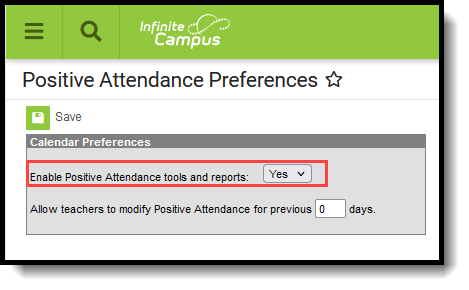 Positive Attendance Preferences
Verify the teacher has proper tool rights to record Positive Attendance.
Course Information
Tool Search: Course Information, Course Sections
Create 21st Century courses for the calendar, or verify they exist in the calendar. When calendar attributes are rolled forward from previous years, 21st Century courses can be marked to roll forward to the next calendars.
The Course Name and Course Number should indicate that it is a 21st Century course.
 21st Century Course Number and Name
- Mark the Positive Attendance checkboxes.
- Select the 21st CCLC program in the 21st CCLC field. The values available for this field are determined by the state of Arizona and cannot be modified.
- Select the appropriate 21st CCLC Activity Type for this course. See the CCLC Activity Type table for more information.
 21st Century fields on Course Information
CCLC Activity Types
| Code | Name | Description |
|---|---|---|
| 001 | Literacy Education | Those activities that contributed to the development of reading and language arts skills and to the enjoyment of reading.
Examples: Reading tutoring, breakfast reading clubs, writing club, reader's theatre, Project LIT |
| 002 | Science, Technology, Engineering, and Mathematics, including Computer Science | Any classes that contributed to the development of science, technology, engineering, or mathematics skills, including any combined STEM classes. This includes all mathematics classes. In addition to traditional STEM classes, add the math classes you offered that align to the site’s approved math objective(s).
Examples: Math tutoring, coding classes, STEM club, robotics, Girls Who Code, 3D printing, Young Builders Club, gardening club |
| 004 | Healthy and Active Lifestyle | Those activities that engage students in a physical activity and/or cultivate the appreciation of a healthy and active lifestyle.
Examples: Martial arts, fitness class, cooking class, mountain bike club, yoga club, discing for kids, sports clubs, dance class, folklorico, gardening club |
| 005 | Cultural Programs | Activities or classes that contributed to an enhanced understanding of culture.
Examples: Cooking around the world, folklorico, foreign language, music, girls teaching girls, art history |
| 006 | Telecommunications and Technology Education | Classes that contributed to the development of telecommunication and related technology skills.
Examples: E-sports, Multimedia Club, Podcast/Movie Making |
| 007 | Expanded Library Service Hours | Activities that contributed to expanded access to library resources, including time and personnel.
Examples: Expanded Library Ti |
| 008 | Assistance to Students who have been Truant, Suspended, or Expelled | Those activities/classes that target students with content related to truancy, suspension, and expulsion.
Examples: Check- Club, Leadership Club, Truancy Prevention Camp |
| 009 | Drug and Violence Prevention and Counseling | Those activities that promoted peaceful conflict resolution, that provided information about the dangers of drug use, or that provided socio-emotional counseling services.
Examples: MATforce, Horse therapy, grief group |
| 010 | Career Competencies and Career Readiness | Those activities that prepare students to enroll and succeed in a credit-bearing course at a post-secondary institution or a high-quality certificate program with a career pathway to future advancement. Include also classes that provide an introduction to potential careers for all grade levels, career training, or job prep.
Examples: FAFSA prep, AP course prep, CTE classes, Mechanic certification program |
| 011 | Well-rounded Education Activities, including credit recovery or attainment | Courses, activities, and programming in subjects such as foreign languages, civics and government, economics, arts, history, geography, music, and any other subject with the purpose of providing all students access to an enriched curriculum and educational experience.
Examples: Credit recovery or attainment, volunteerism, community service, accelerated learning, Civics, economics, geography, American history, Government, community involvement, Student Council, Arts and crafts, music, entrepreneurship |
| 012 | Services for Individuals with Disabilities | Those activities designed to directly support students identified as individuals with disabilities, including students who have an IEP or 504.
Discuss with the Evaluation Specialist classes you think may fit here. |
| 013 | Activities for English Learners | Those activities designed to directly support students classified as English learners.
Discuss with the Evaluation Specialist classes you think may fit here. |
| 014 | Academic Enrichment - Accelerated Learning | Out-of-school-time academic programming is explicitly designed to extend, deepen, or advance student instruction beyond basic grade-level expectations. Rather than focusing on remedial or catch-up interventions, this category encompasses high-quality, rigorous coursework that challenges students, maximizes their academic potential, and develops advanced problem-solving skills. |
| 015 | Academic Enrichment - Mentoring Program | Structured, sustained programs or interventions implemented during non-school hours that utilize positive role models to guide, motivate, and support target student cohorts. To qualify under this "Academic Enrichment" subcategory, the mentoring framework must directly connect its relationship-building goals to the student's regular academic objectives, school attendance compliance, or college-and-career readiness pathway. |
| 016 | Academic Enrichment - Remedial Education or Tutoring Services | Structured instructional support and targeted interventions delivered to individual students or small groups during non-school hours. This activity category is specifically aligned with regular school-day curriculum goals to help struggling learners catch up, master core state standards, complete homework assignments, and overcome documented academic deficits in core subject areas (primarily Literacy, Mathematics, and Science). |
| 017 | Financial Literacy | Instructional programs, modules, or workshops delivered during non-school hours that are designed to build foundational knowledge of personal finance, money management, and economic concepts. Activities under this code must empower participants—whether students or their adult family members—to develop critical thinking skills regarding budgeting, saving, investing, and the long-term impacts of financial decisions. |
Ed-Fi Configuration
Tool Search: Configuration
When configuring the Sessions Resource (Reporting > Ed-Fi > Configuration > Session), the Term Detail can be populated with the 21st CCLC Calendar, or it can be left blank. There is no impact either way to reporting sessions; as long as the Sessions Resource is set to ON, information reports.
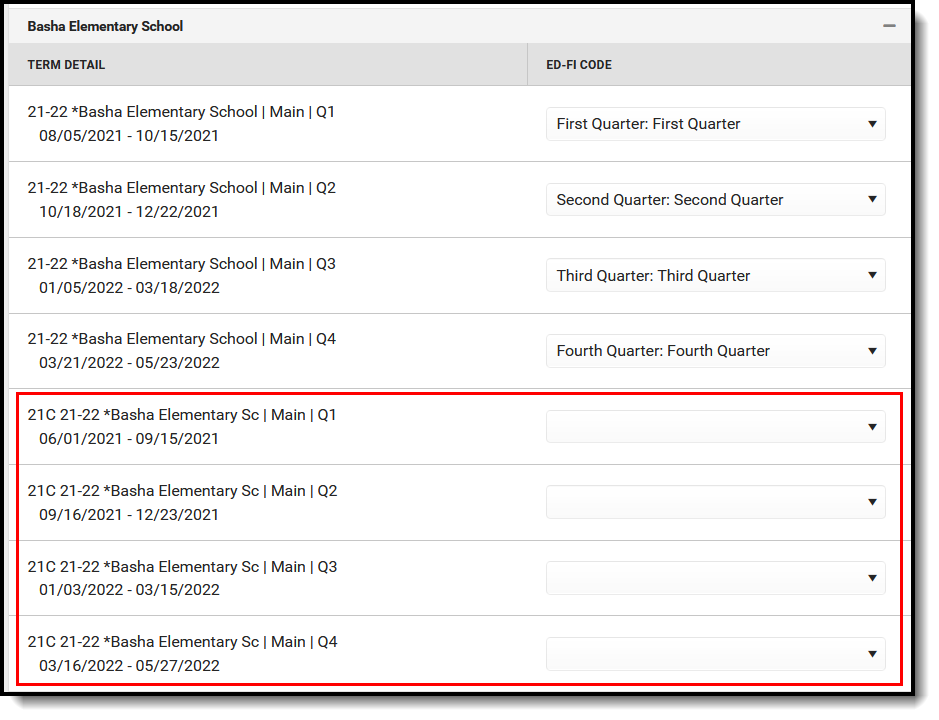 Sessions Resource Configuration - Term Detail