Path: Student Information > General > Enrollments
The Enrollments tool displays all enrollments that have been entered for a student. These can include both in-district enrollments and enrollment information for schools the student attended outside the district.
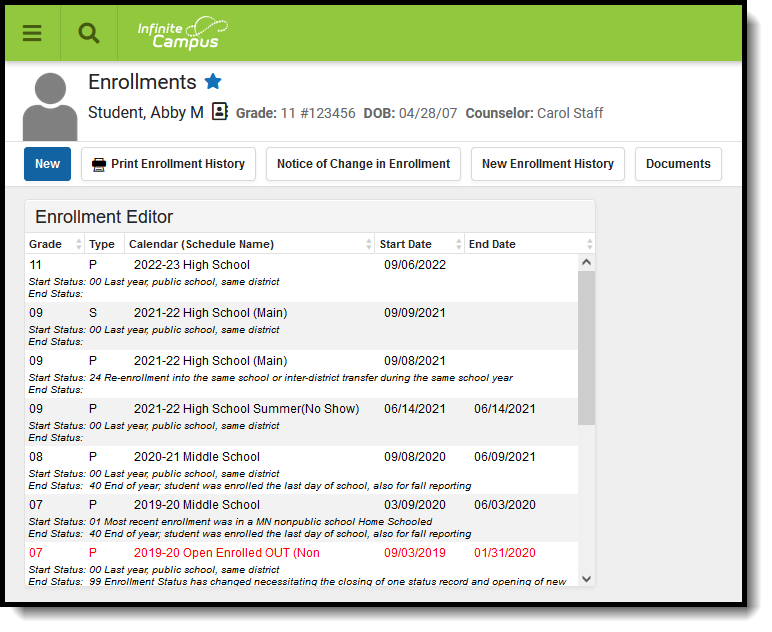 Each student has a record of their enrollments.
See the Student Enrollments Tool Rights article for information about rights needed to use this tool.
Enrollment information in Ad hoc query wizard
Student Enrollment information is available in the Query Wizard for Student data types. When building Student data type filters, the fields are available in the Learner > Active Enrollment, All Enrollments and Enrollment History folders.
- Use the Active Enrollment fields to report current year enrollment information. These fields are labeled as activeEnrollment.XXX.
- Use the All Enrollments fields to report information for all enrollment records - current year enrollments, past enrollments and future enrollments. These fields are labeled as histEnrollment.XXX.
- Use the Enrollment History fields to report enrollment information that was added using the New Enrollment History icon. These fields are labeled as enrollmentHistory.XXX.
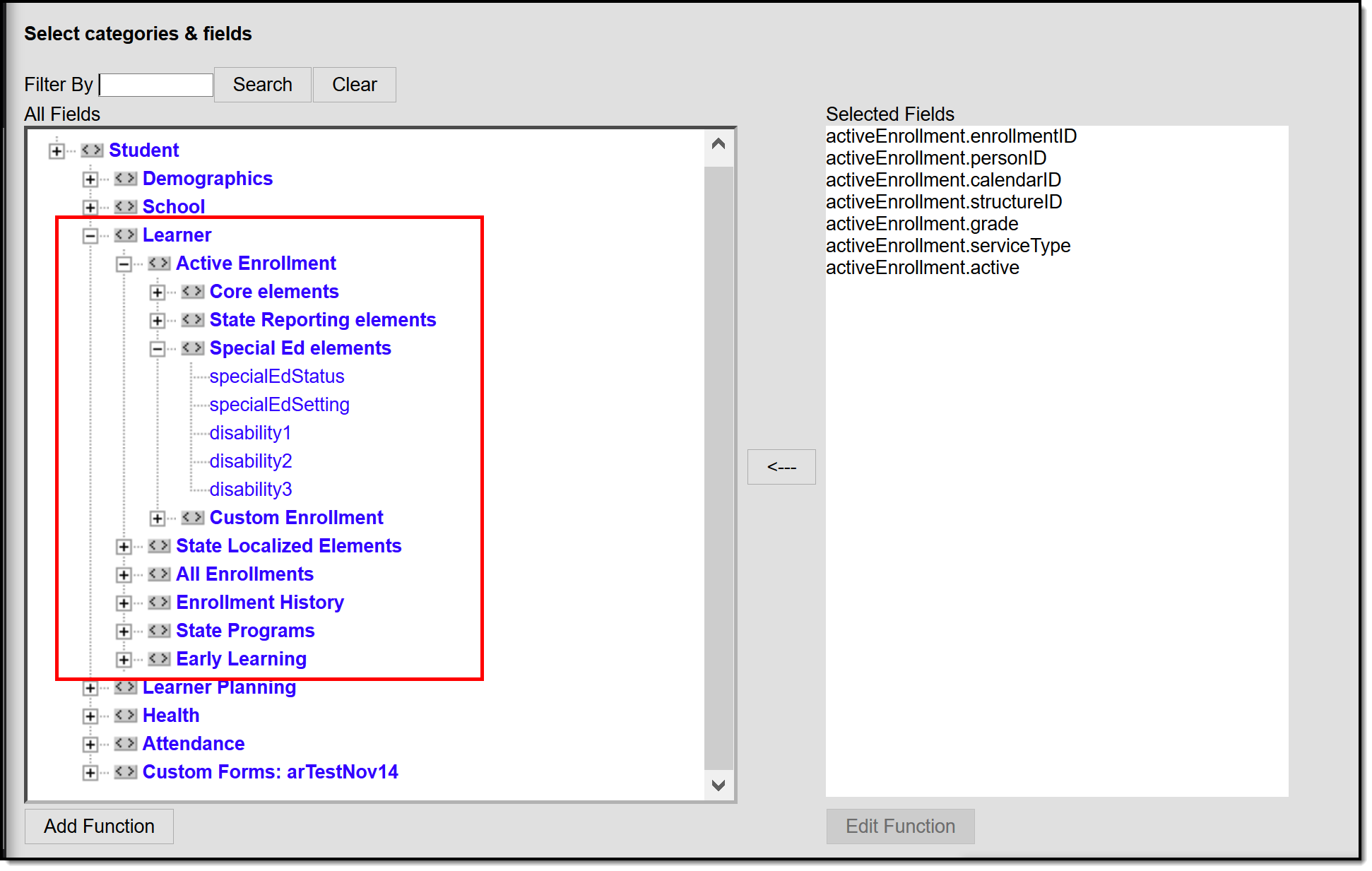 Enrollment fields can be added to Ad hoc queries.
In each of these areas, fields from each of the Enrollment editors can be selected:
- General Enrollment Information fields can be selected from the Core Elements folder. These fields are included in the description of the General Enrollment Editor section on this document.
- State Reporting Enrollment fields can be selected from the State Reporting Elements folder. Depending on your state, additional localized fields may be located in the State Localized Elements folder. These fields vary by state and are noted on localized state reporting articles.
- Special Ed Enrollment fields can be selected from the Special Ed Elements folder. These fields vary by state and are noted on localized state reporting articles.
- Custom fields added by districts can be selected from the Custom Enrollment folder. Please note that custom fields (added in the Custom Attribute/Dictionary) that are marked as Hide do NOT display in Ad hoc Reporting.
Available Ad hoc fields are included in this document for reference.
Features of enrollments
For information on Cross-Site Enrollments, see the Enrollment Information for Cross-Site Students.
When hovering over an enrollment entry, the person who last modified the data displays in the hover box.
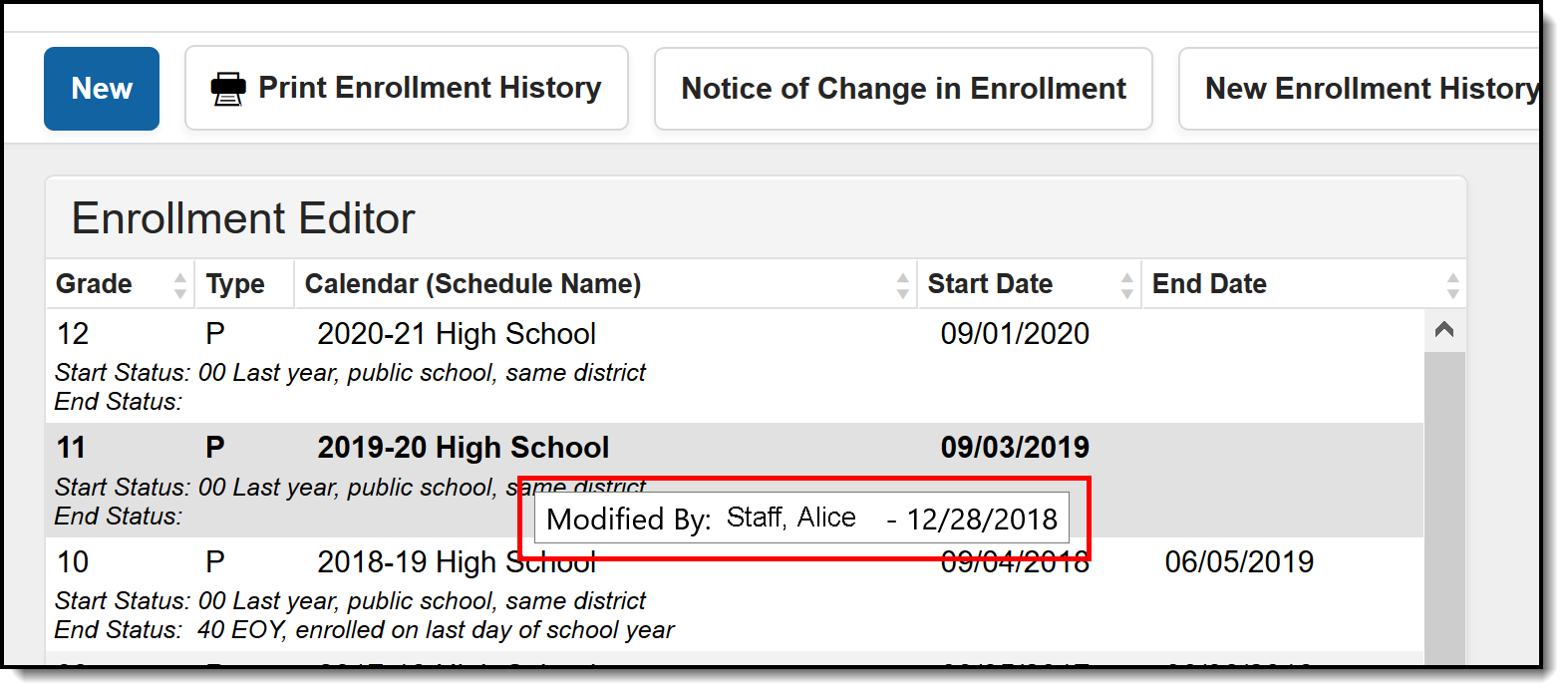 View when and by whom a record was last modified.
To see specific information about an enrollment record, open the desired entry by clicking on the enrollment.
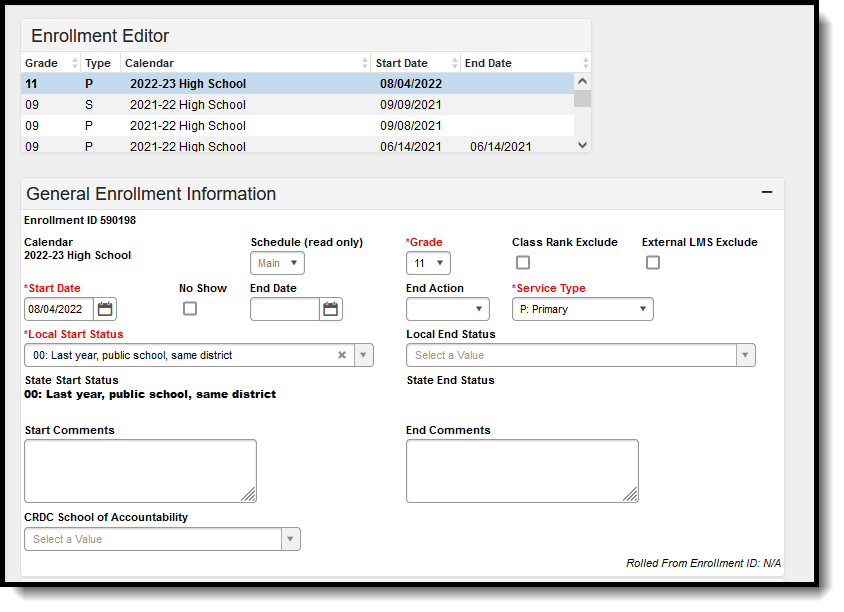 View details about a selected enrollment for a student.
When adding a new enrollment, a school and calendar need to be selected from the toolbar.
The student's current grade level for the selected school year displays in the Student header (and throughout all Student Information tools). This grade level displays in the search results and the list of enrollments in the Enrollment Editor.
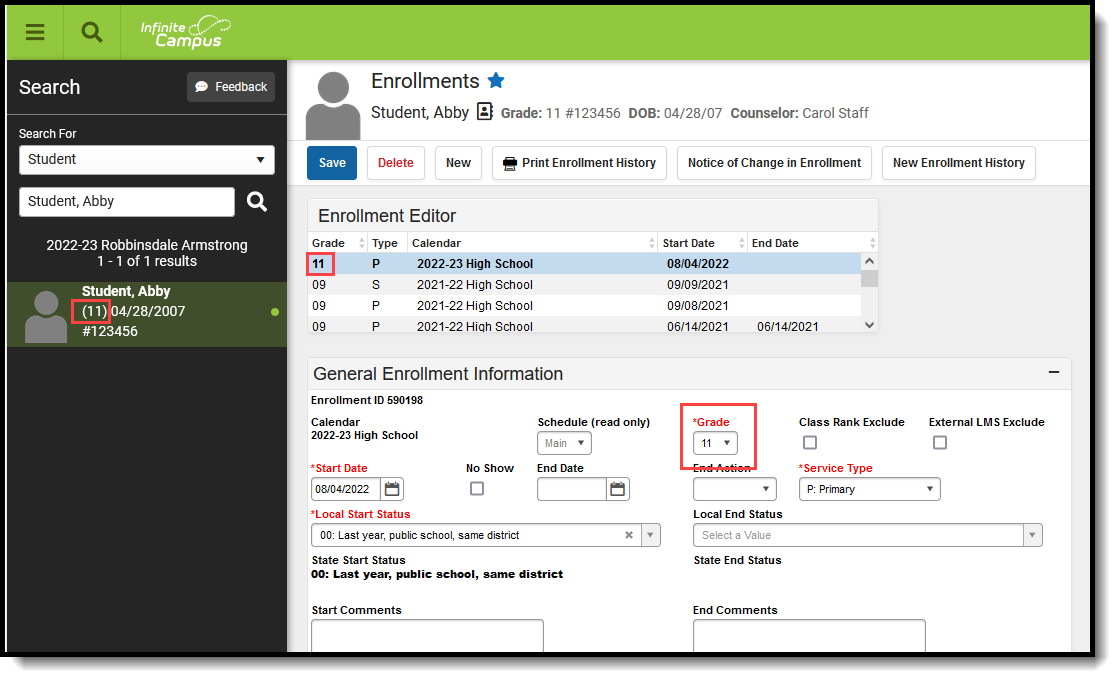 A grade level must be selected for a given enrollment.
The display of Enrollments follows this logic order:
- The active, primary enrollment from the active school year displays.
- When there is more than one active primary enrollment, the most current primary enrollment displays.
- When there is more than one active enrollment and no enrollments are primary, the most current one is used regardless of enrollment type (partial or special education).
- The most current, non-active primary enrollment in the active school year displays.
- The most current, non-active, non-primary enrollment in the active school year displays.
- When there are no enrollments in the active school year, no enrollments display.
When a student's enrollment is ended or deleted, and attendance data is removed, a record of that action is recorded in the Audit Attendance table.
When an inactive start status is marked as the default start status in the Attribute/Dictionary, and a new enrollment is created for a student, an active start status must be selected prior to saving the enrollment.
When a student has multiple enrollments in the same school year, but is enrolled in different grade levels and different schools, the grade level associated with the Primary enrollment (Service Type set on the enrollment editor) displays in the search. When both enrollments are Primary, the most recently created grade level displays in the search results.
In the example below, the student has two active enrollments in different grade levels and different schools, both with Primary Enrollment Service Types. No matter the calendar that is selected in the Context, the student's most recently created enrollment record - in this case, the enrollment associated with grade 02 - displays in the search results, even though the selected calendar is the student's Grade 01 enrollment.
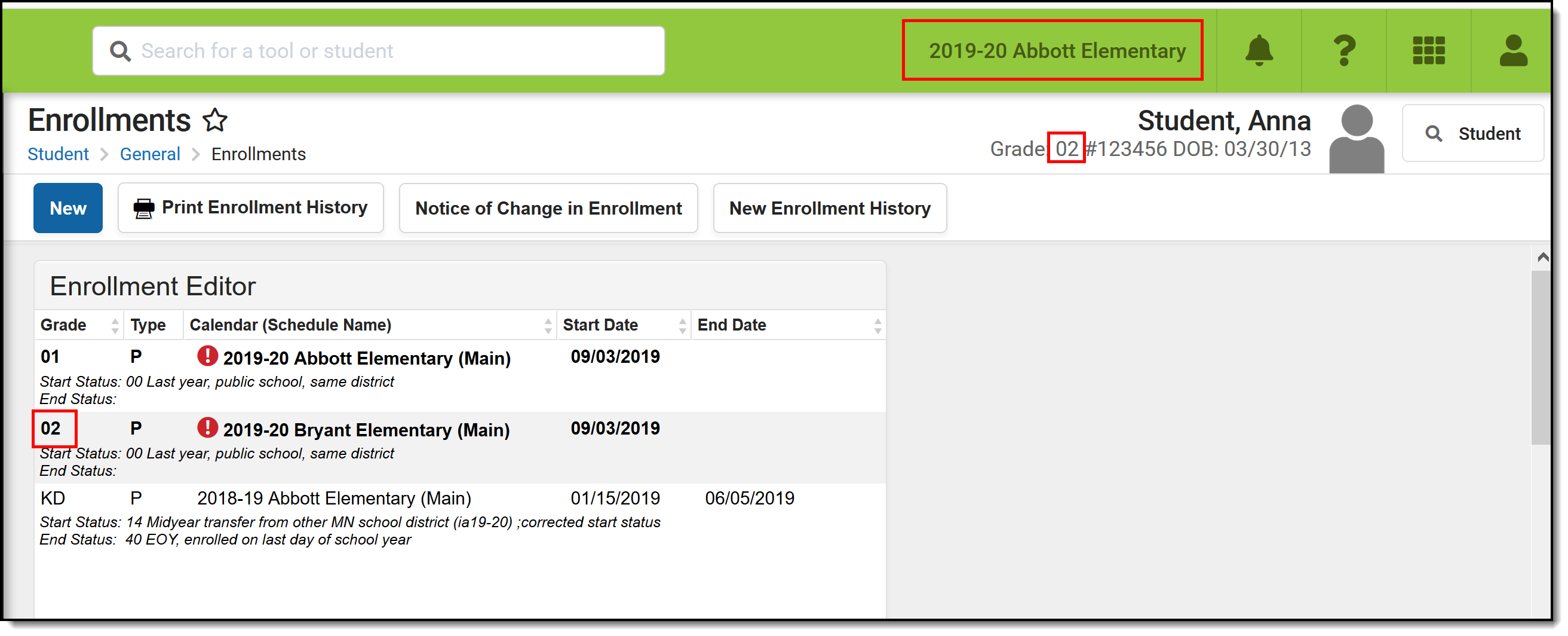 This student has two active primary enrollments.
In the example below, the student has two active enrollments in different grade levels and different schools, only one enrollment is considered Primary. The grade level associated with the Primary enrollment - in this case, the grade 01 enrollment - displays in the search results, even when the school selected in the context is the most recently created enrollment record.
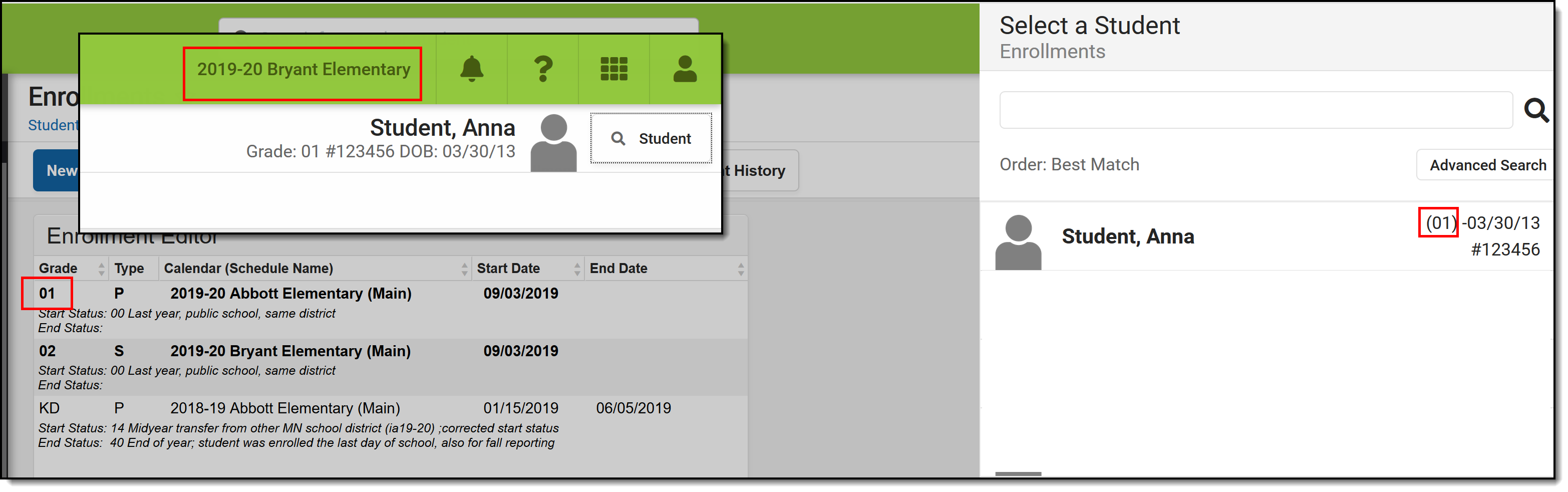 This student has a primary and a secondary enrollment.
Enrollment system preferences
See the System Preferences article for more information.
Enrollment overlap behavior
Districts can determine how enrollments with overlapping start dates behave.
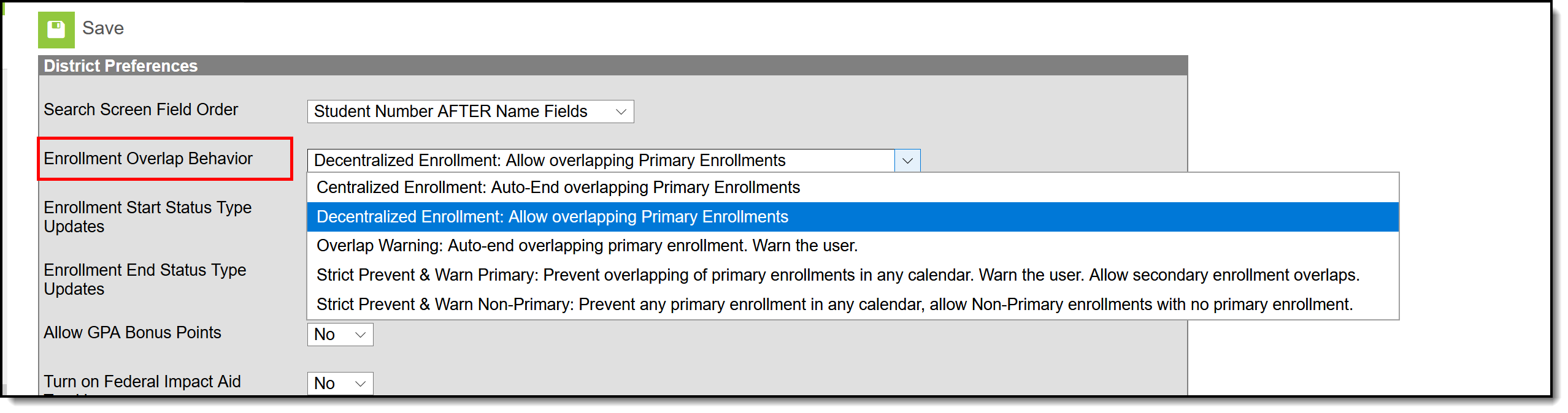 Enrollment Overlap System Preferences
| Preference | Details |
|---|---|
| Centralized Enrollment: Auto-End Overlapping Primary Enrollments | This option automatically enters an End Date for the old primary enrollment when a new overlapping enrollment is created. This date is the date before the Start Date of the new enrollment record.
When a new non-primary enrollment has the same date as another primary enrollment, both enrollments remain active.
When the start dates are the same, a message displays indicating the primary enrollment cannot overlap with another primary enrollment. The existing enrollment ends with the entered start date and is set to No Show. |
| Decentralized Enrollment: Allow Overlapping Primary Enrollment. | Allows primary enrollments to overlap. Red exclamation points display next to the overlapping enrollments on the Enrollments tool. |
| Overlap Warning: Auto-end overlapping primary enrollment. Warn the user | Warns the user when a new primary enrollment overlaps with another primary enrollment. The user may click OK and continue creating the enrollment. The new enrollment's start date is compared to any existing enrollment's start date.
When the start dates are the same, a message displays indicating the primary enrollment cannot overlap with another primary enrollment. The existing enrollment ends with the entered start date and is set to No Show. |
| Strict Prevent and Warn Primary: Prevent overlapping of primary enrollments in any calendar. Warn the User. Allow secondary enrollment overlaps | This option prevents the overlapping of primary enrollment records in any calendar.
A warning appears when the user attempts to create a new primary enrollment which overlaps another primary enrollment. The enrollment is not be saved and selecting OK on the warning message results in an error displaying. This option DOES NOT allow partial enrollments to exist without there already being a primary enrollment. This prevents the ability to have two enrollments in the same calendar, even if the enrollments are in separate schedule structures and even if the enrollments are varying service types (primary, secondary, etc.). This option DOES NOT prevent the creation of a new Primary enrollment that overlaps a No Show enrollment. |
| Strict Prevent and Warn Non-Primary: Prevent overlapping primary enrollments in any calendar, allow Non-Primary Enrollments with no primary enrollment | This option prevents primary enrollments from overlapping in any calendar, but non-primary enrollments can overlap if there are no primary enrollments.
This prevents the ability to have two enrollments in the same calendar, even if the enrollments are in separate schedule structures and even if the enrollments are varying service types (primary, secondary, etc.). This option DOES NOT prevent the creation of a new Primary enrollment that overlaps a No Show enrollment. |
A preference for setting the enrollment end status may be required, depending on the selected overlap preference.
When there is an overlapping enrollment, a red exclamation point displays next to the affected enrollment records. This alert does not display when one of the enrollments is marked as a no show.
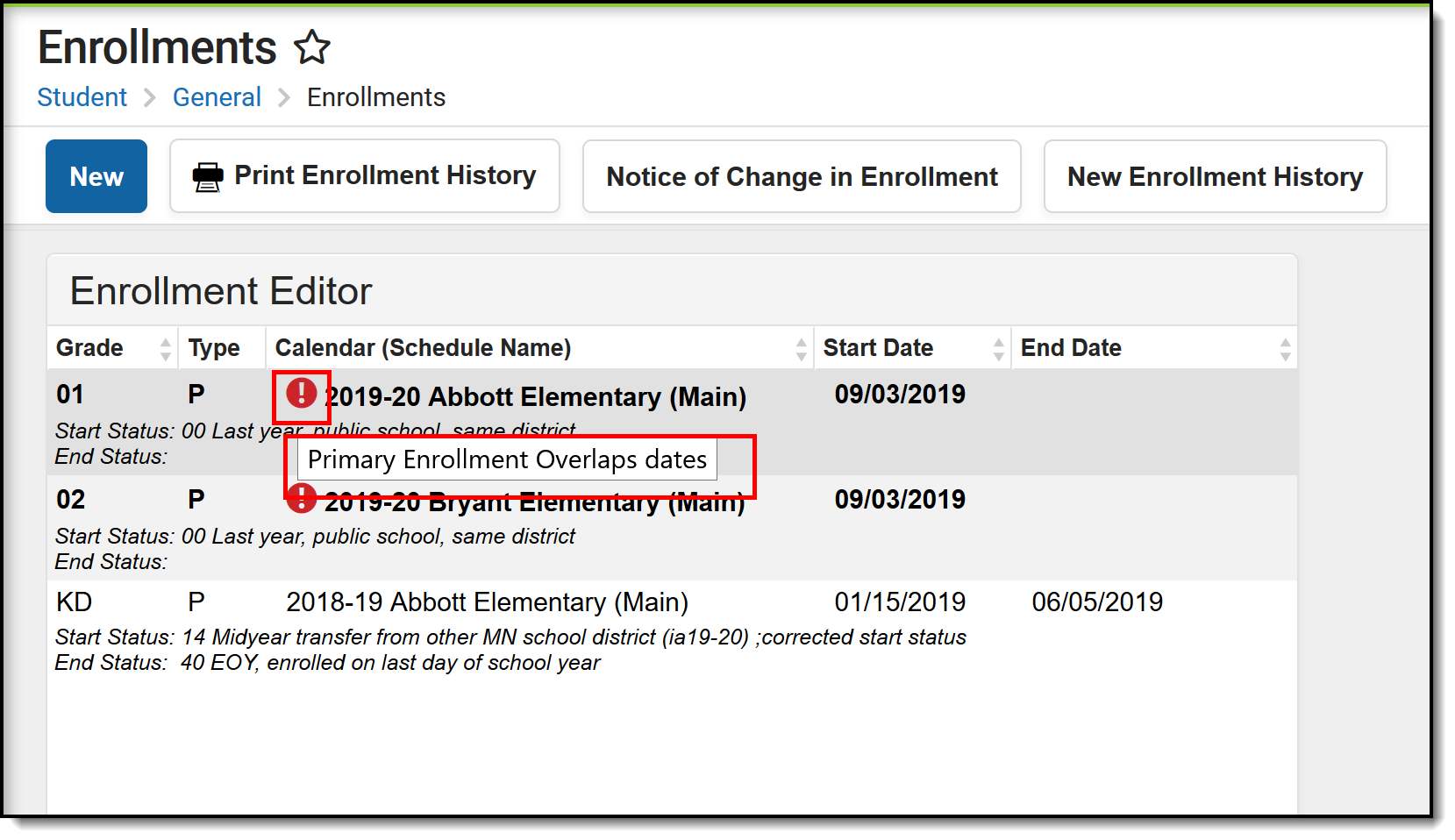 Overlapping Enrollment Alert
Cascade enrollment end date to blended learning group assignment end date
A System Preference is available for districts to determine whether Blended Learning Group Assignments are ended when the enrollment record is ended.
When the System Preference for Cascade Enrollment End Date to Blended Learning Group Assignment End Date is set to Yes, adding an End Date to the enrollment record, whether manually on a single student's enrollment record or when using the Enrollment End Batch, Blended Learning Group Assignments are also ended for the same date.
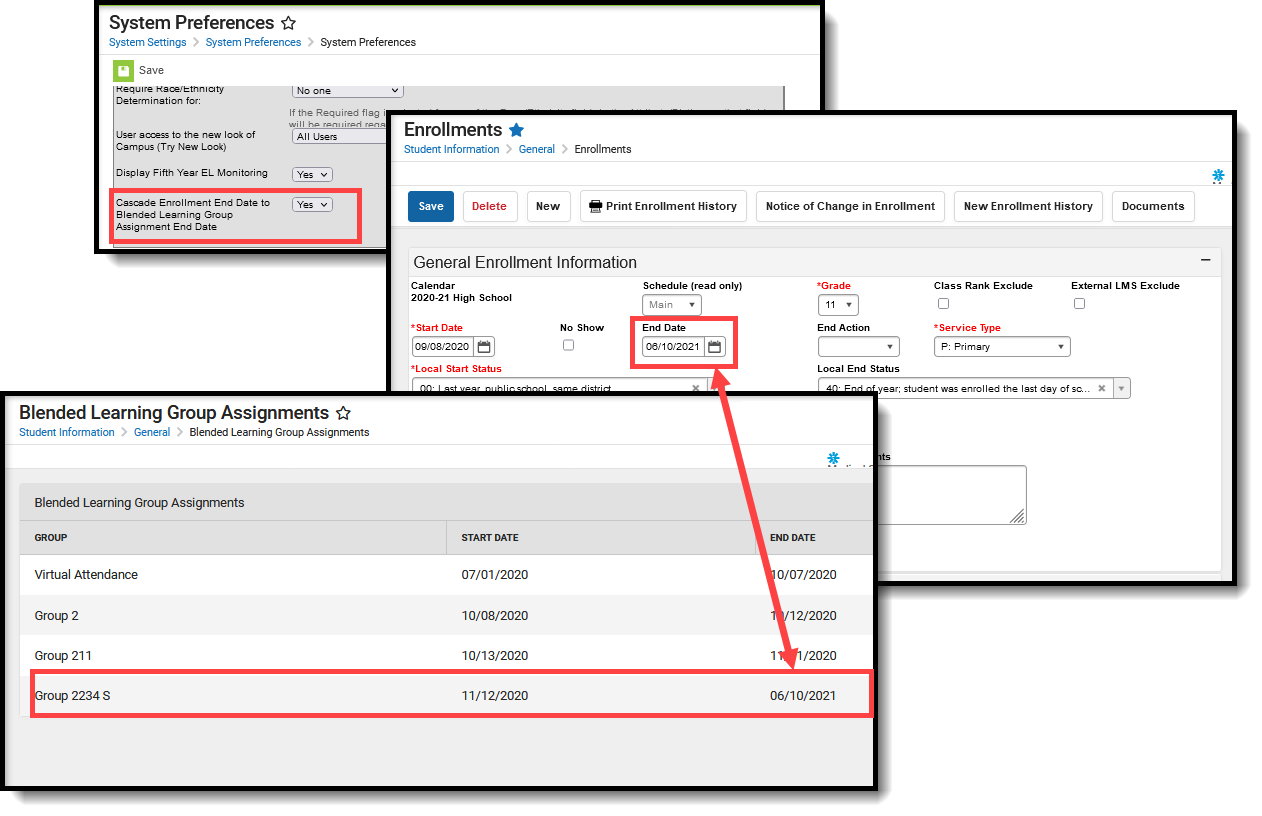 Ending an Enrollment Record with Cascade System Preference Turned On Ends the Blended Learning Group Assignment
- When a student has overlapping enrollments, end dating one enrollment does not update the Blended Learning Group Assignments. There is no way to determine to which enrollment the Blended Learning Group Assignment is associated.
- When an enrollment is marked as No Show, the student's Blended Learning Group Assignments are deleted.
- When an enrollment is deleted, the Blended Learning Group Assignments are deleted.
Enrollment information on Student Summary
Enrollment information displays on the Summary tool when viewing the household information. Enrollment information for the selected student and any other members of the student's household who are also students have an entry in the Enrollment (grade) column. This displays the most current primary enrollment information for those members (school of enrollment and grade level).
- Future enrollment information does not show until the start date of that enrollment.
- If a student has multiple enrollments in the current school year, only the last grade level completed (last enrollment with an end date in a past calendar) displays, regardless of the enrollment end date.
- If a student has enrollments with end dates and enrollments without end dates, the current grade level (from the most recent enrollment) displays.
- Ended non-household relationships set to a relationship of Self are not listed.
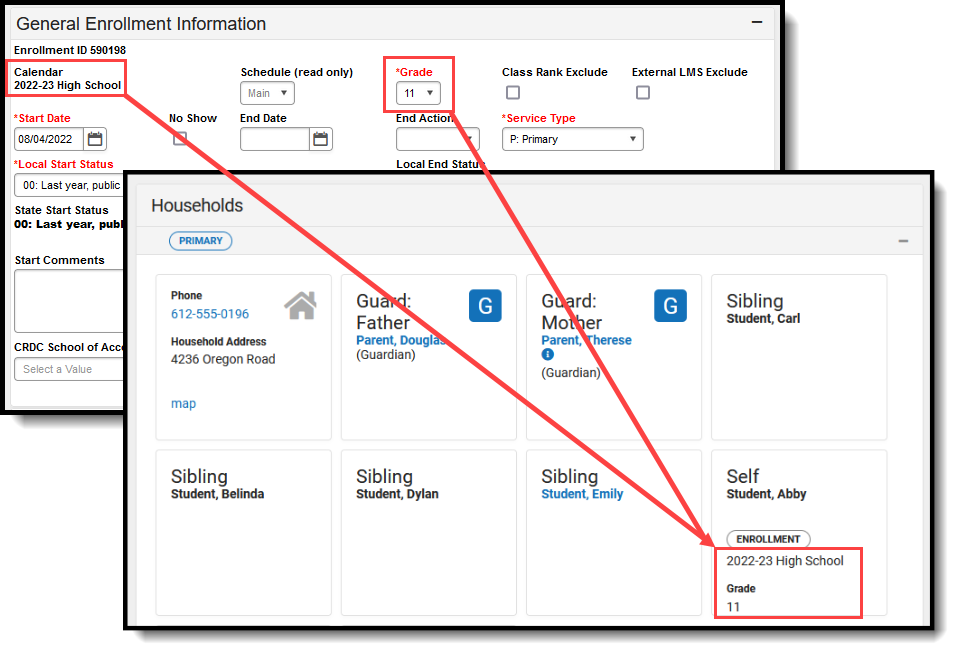
General enrollment editor
The General Enrollment Information section lists the calendar of enrollment, grade level, start and end date, the type of enrollment, the start and end status of enrollment, and any enrollment comments that have been entered. Options available in fields such as start status, end status and service type vary by state.
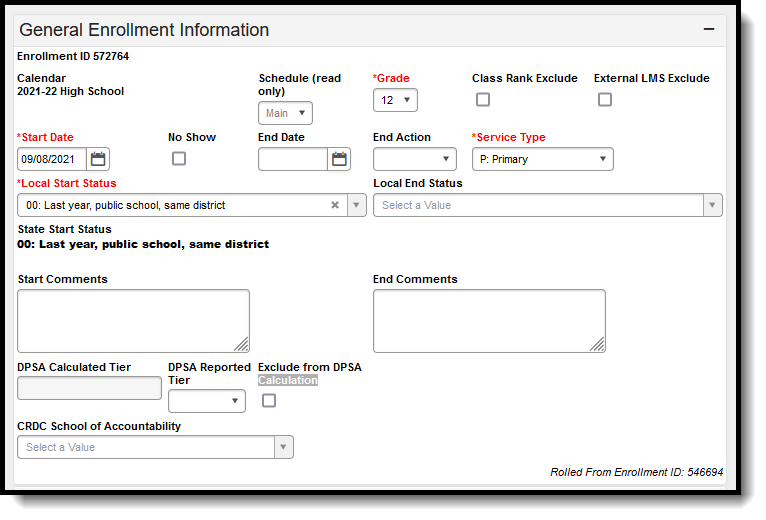 Basic information displays in the general enrollment information editor.
The following table provides definitions for each data element on the General Enrollment editor.
Data Element |
Definition |
Ad hoc Fields |
|---|---|---|
| Enrollment ID | Displays the unique identification number of the enrollment record from the database. This is a read-only field and is for informational purposes only. | activeEnrollment.enrollmentID
histEnrollment.enrollmentID enrollmentHistory.enrollmentID |
Calendar |
Lists the name of the school and school year into which the student is enrolled. |
enrollmentHistory.calendarName |
Schedule |
Displays the schedule structure of the calendar into which the student is enrolled. |
schedStructure.name histSchedStructure.name |
Grade |
Indicates the grade level of the enrollment record. Grade levels should be mapped to state grade levels for proper reporting. |
activeEnrollment.grade histEnrollment.grade enrollmentHistory.grade |
Class Rank Exclude |
Indicates this enrollment record is not included in class rank calculations. This is often selected for foreign exchange students or special education students. |
activeEnrollment. classRankExclude histEnrollment.classRankExclude |
Start Date |
Lists the first day of instruction for this enrollment record.
When a start date is changed on an enrollment record, a warning displays indicating that any previously entered attendance that may have occurred prior to the new start date is not deleted, unless the student's start date in course sections is also adjusted.
If the student's enrollment already has an end date (or where an end date is entered when the start date is adjusted), attendance that is outside of the start/end dates are deleted. |
activeEnrollment.startDate histEnrollment.startDate enrollmentHistory.startDate |
No Show |
Indicates the student never attended the school during the allotted time period determined by the district. State and/or district policies determine when a student's enrollment is actually ended.
This field may not display in your state.
See the No Show section for more information. |
N/A |
End Date |
Lists the last day of instruction for this enrollment record.
When an enrollment is ended and there are no other enrollments for the student, the student's schedule is also ended.
If the student's enrollment already has an end date (or where an end date is entered when the start date is adjusted), attendance that is outside of the start/end dates are deleted.
An Enrollment record is considered active through midnight on the entered end date. For example, if an enrollment is ended for a staff person as of September 19, it is considered active until midnight on September 19. At 12:01am on September 20, the enrollment record is no longer active. |
activeEnrollment.endDate histEnrollment.endDate enrollmentHistory.endDate |
End Action |
Indicates the action of promoting, retaining or demoting a student to the next, same, or previous grade level for the next school year.
See the End Action section for more information. |
activeEnrollment.endAction histEnrollment.endAction |
Service Type |
Indicates the type of enrollment and the intended service the student receives. Service types are Primary, Partial (Supplemental) or Special Education unless localized for a specific state.
|
activeEnrollment.serviceType histEnrollment.serviceType enrollmentHistory.serviceType |
Local Start Status |
Lists the local enrollment start code for the student.
Start Statuses vary by state. |
activeEnrollment.startStatus histEnrollment.startStatus enrollmentHistory.startStatus |
Local End Status |
Lists the local enrollment end code for the student.
End Statuses vary by state. |
activeEnrollment.endStatus histEnrollment.endStatus enrollmentHistory.endStatus |
| State Start Status | Displays the state start status mapped to the assigned local start status. | N/A |
| State End Status | Displays the state end status mapped to the assigned local end status. | N/A |
Start Comments |
Displays any comments about the start of the enrollment - who entered the enrollment, verified information, etc. |
activeEnrollment.startComments histEnrollment.startComments enrollmentHistory.startComments |
End Comments |
Displays any comments about the end of the enrollment. |
activeEnrollment.endComments histEnrollment.endComments enrollmentHistory.endComments |
| Rolled From Enrollment ID | Displays the identification number of the enrollment record from which the enrollment was rolled forward.
This only displays when the enrollment was created using the Enrollment Roll Forward tool. When an enrollment is manually created in the calendar (e.g., NOT created using the Roll Forward tool). a value of N/A displays. |
activeEnrollment.rollForwardEnrollmentID
histEnrollment.rollForwardEnrollmentID |
End action
The following definitions define the available End Actions for an enrollment. These options are used in the Enrollment Roll Forward Wizard.
Term |
Description |
Logic |
|---|---|---|
D |
Demote |
Indicates a student will be a lower grade level for the next school year (for example, a student enrolled in grade 3 will be in grade 2 in the next school year). |
P |
Promote |
Indicates the student will increase at least one grade level for the next school year (student moves from grade 3 to grade 4). This is the default setting and does not need to be selected for students moving to the immediate next grade level. |
R |
Retain |
Indicates a student will remain in the same grade level for the next school year (student will be enrolled in grade 3 next year, and is currently enrolled in grade 3). |
No show enrollments
Each state, district and education agency determines the No Show policy for their schools. The following provides a best use for this checkbox so districts can determine the best use of this checkbox.
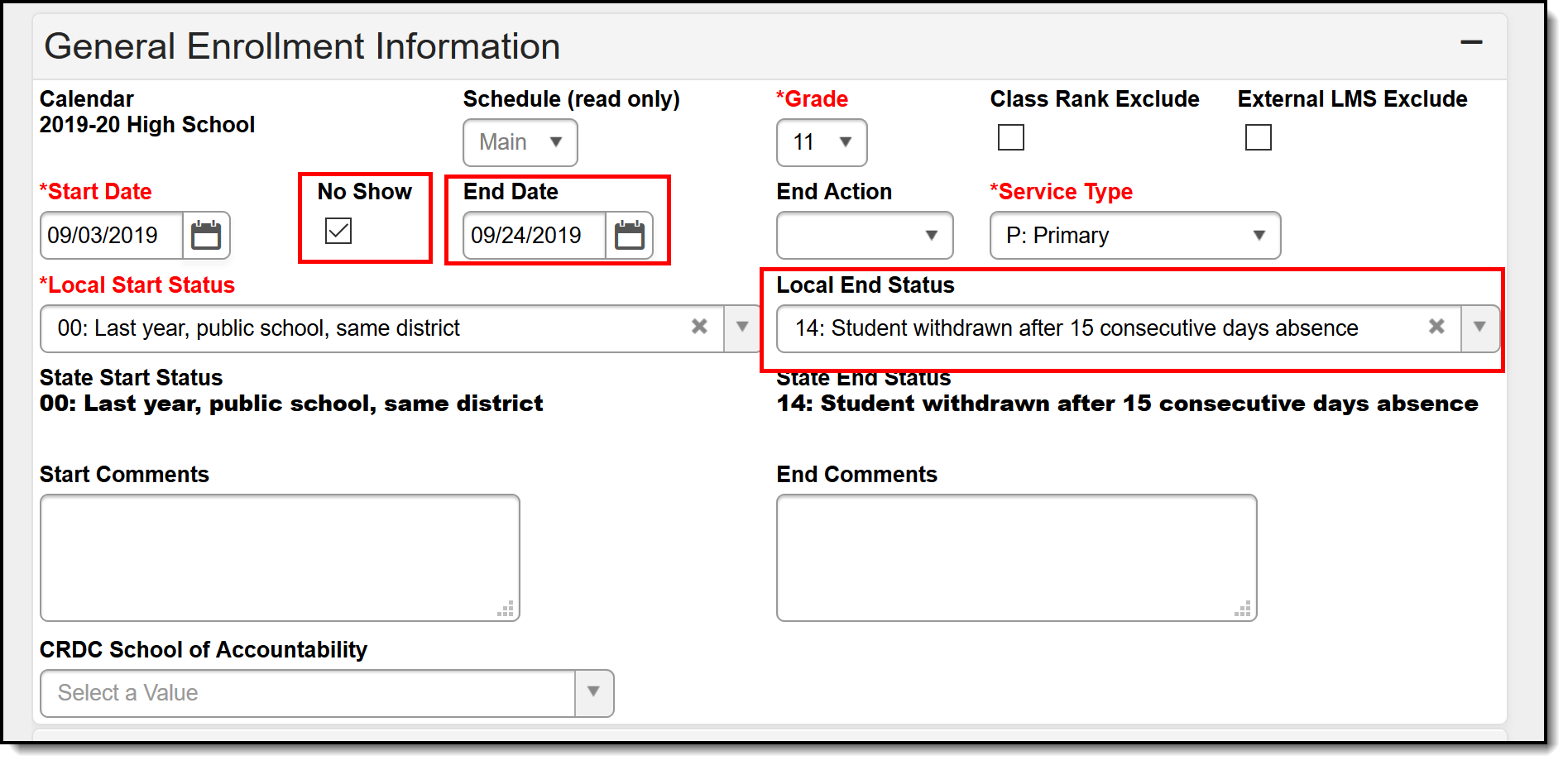 These three fields are used to record No Show information.
Enrollments usually aren't marked as No Show until a certain number of days passes and the student has never been considered present in any scheduled course sections. Up until this date (10 days after school starts, for example), the student is marked absent with an unknown excuse. At the time the student is considered a No Show, the checkbox on the enrollment record is marked, an End Date is entered for that enrollment, and an appropriate End Status is assigned.
Upon saving the record, the following happens:
- A message displays on the Walk-In Scheduler view of the Student Schedule, indicating the end date is not within the section's start and end dates.
- An End Date that is one day prior to the calendar start date is placed on the student's Schedule. For example, a Drop Date of 06/30/2021 displays on the student's Schedule when the Calendar Start Date is 07/01/2021. This means the End Date on the Schedule is not the same end date that is entered on the Enrollment record.
- An End Date that is one day prior to the term start date is inserted into the student's existing roster records that are tied to the enrollment for which the checkbox is marked.
- Students are removed from section rosters and attendance is removed as of the End Date entered on the enrollment.
- Attendance records are not reported in the ADM and ADA Detail Report.
- Students report on the No Show Report.
- Students may not be included in state reports and extracts, dependent on the specific report logic.
- Students are not included in any student search results. They are included in an All People or Census search.
- Transcripts do not display Cumulative GPA, Class Rank or Percentile.
- Students return in red font when searched, since they are no longer an active student. The following logic is used:
When a student has a No Show enrollment followed by another ended enrollment in the same calendar, the student displays in red the day after the subsequent enrollment is ended or after the last day of the calendar.
When a student has a No Show enrollment followed by another future enrollment in the same calendar, the student displays in red until the Start Date of the subsequent enrollment.
When a student has an ended enrollment followed by another No Show enrollment in the same calendar, the student displays in red beginning the day after the enrollment End Date.
When a student has only a No Show enrollment in the calendar they do not display in the Student Search at all.
Options for using the No Show checkbox
- On the first day of school, all students who are absent are marked as No Show to remove them from attendance. After a prescribed number of days, the enrollment is either deleted or ended. In order to not have a membership record in the current calendar year, the enrollment would need to be ended prior to the first day of school. Therefore, the calendar must be set to start one day before the Term start date. If and when the student finally appears, a new enrollment would be created with the actual start date.
- For districts where the state pays for a set number of days at the start of school, even though the student has not appeared, the following steps should be followed:
- A school enrolls a student in the upcoming calendar.
- The student is scheduled into the appropriate course sections.
- The student doesn't show up for the first 10 or so days of school. Up until that point a school is marking that student as absent unknown. From that point on, a student is flagged as a 'no show' with an enrollment end date using that threshold date.
- At any time afterwards, a week or several months, the student shows up.
- The school leaves the current enrollment records as is with the 'no show' flag marked
- A new enrollment record for that student, with the start date of the date the student shows up.
- The school then uses Restore feature on the Walk-In Scheduler to perform a restore of the student's previous schedule, so each course section reflects the appropriate start date of the child's new enrollment.
Future enrollments
The Future Enrollment editor provides information regarding the student’s plan for the next school year (i.e., elementary to middle and middle to high). This should only be used by districts that have multiple school sites for a given grade level.
See the Enrollment Roll Forward article for information on how these fields are used when rolling enrollments into the next calendar.
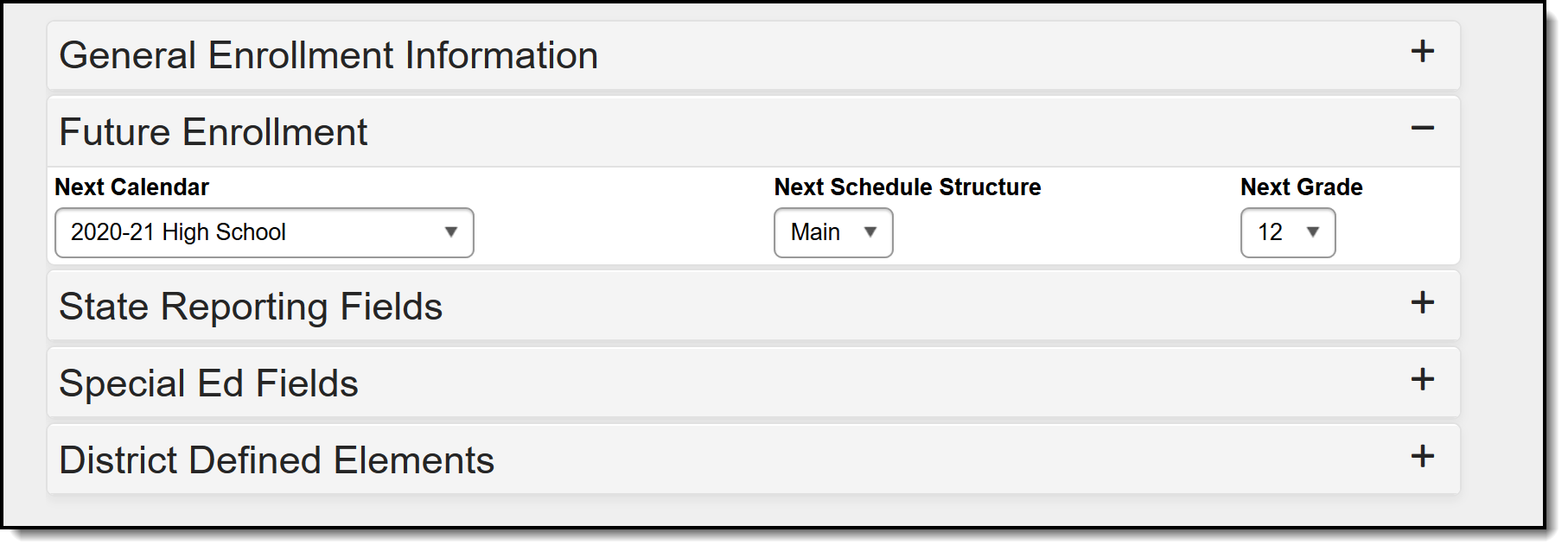 The student's enrollment plan for the next school year is indicated in Future Enrollment.
When a student has the ability to choose a school outside of the student’s school boundary, the Next Calendar and Next Grade need to be chosen. Only future calendars are available for selection based on the calendar chosen in the Campus toolbar (i.e, calendars for school years in the past do not appear for selection).
- If an existing enrollment is selected, the Next Calendar dropdown list displays all calendars greater than or equal to the year of that enrollment that contains the grade level sequences greater than or equal to the grade level selected in the enrollment.
- If a new enrollment is being created, the Next Calendar dropdown list displays all calendars greater than or equal to the Active School Year.
Future enrollment Ad hoc fields
The following fields in the Query Wizard can be selected from the Student > Learner > Active Enrollment (activeEnrollment.XXX), All Enrollments (histEnrollment.XXX), folders, depending on what is needed in the report.
| Enrollment Field | Ad hoc Field |
|---|---|
| Next Calendar | activeEnrollment.nextCalendar histEnrollment.nextCalendar |
| Next Schedule Structure | activeEnrollment.nextStructureID histEnrollment.nextStructureID |
| Next Grade | activeEnrollment.nextGrade histEnrollment.nextGrade |
State reporting fields
The State Reporting Fields editor contains data elements used in state reporting extracts and federal reporting. Fields on this editor vary by state.
Fields vary by state. Please see your state's Enrollment article for more information on Enrollment fields in your state.
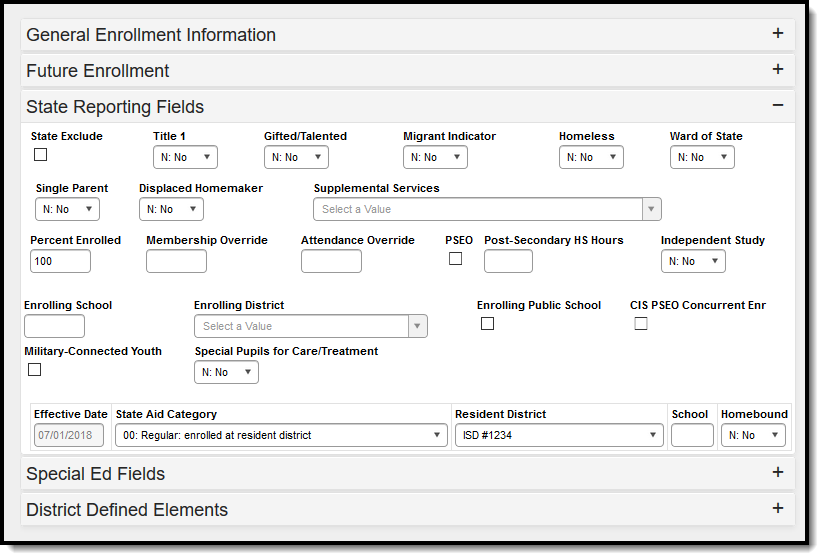 State reporting fields vary by state.
State exclude
If marked, this option excludes a student from reporting on state reporting extracts.
There are two areas in Query Wizard that include State Reporting Enrollment editor fields. Available fields vary by state.
- Student > Learner > State Localized Elements. These fields are labeled as es.XXX.
- Student > Learner > Active Enrollment/All Enrollments > State Reporting Elements. These fields are labeled as activeEnrollment.XXX or histEnrollment.XXX, depending on where it is selected.
State reporting enrollment Ad hoc fields
Additional information about these fields is available in your localized state reporting articles.
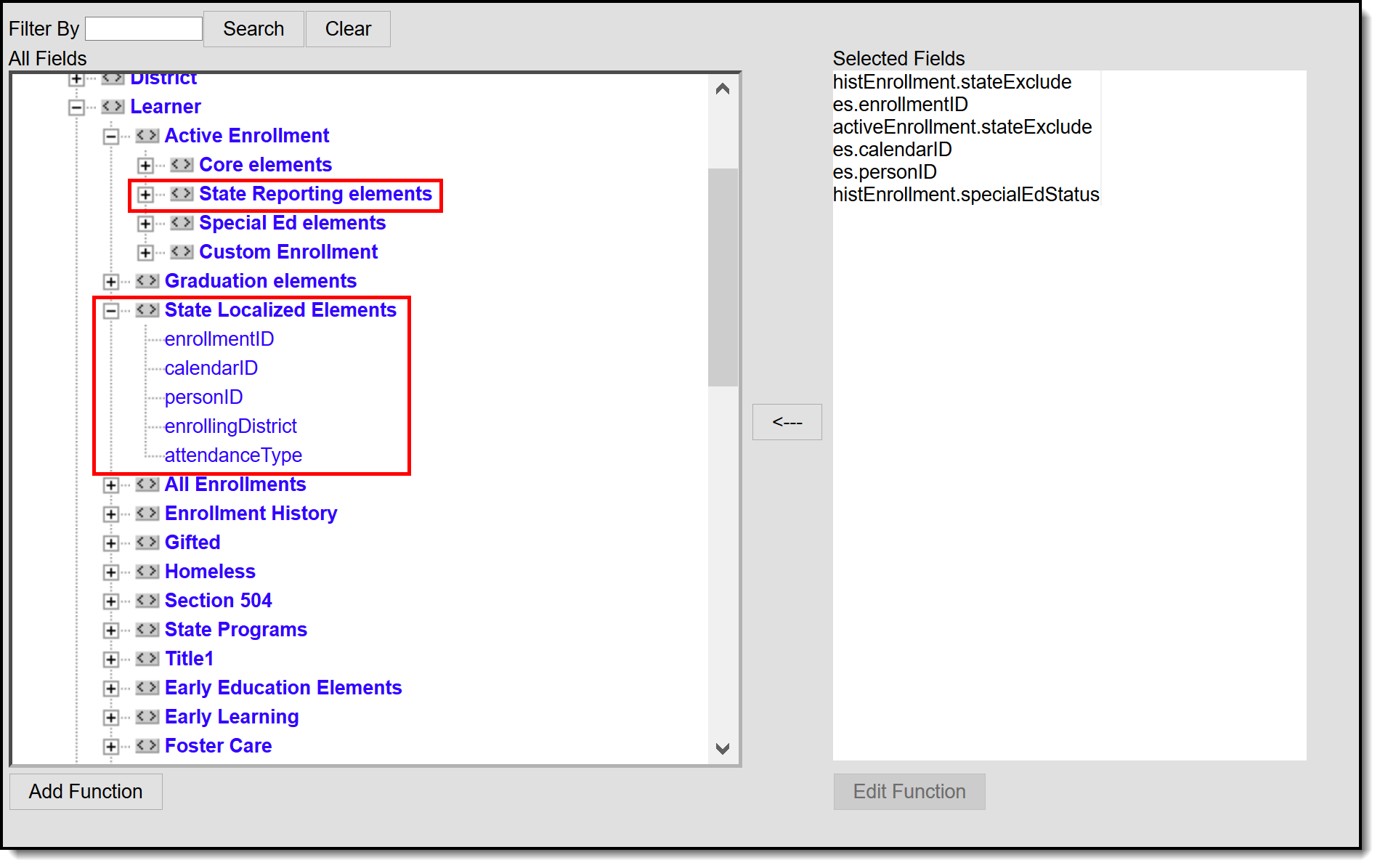 State reporting data can be extracted with an Ad hoc filter.
Special education fields
The Special Education Fields editor lists those items that need to be reported for state reporting relative to students determined to be special education students.
Fields vary by state. Please see the State Tools articles for more information on Enrollment fields in your state.
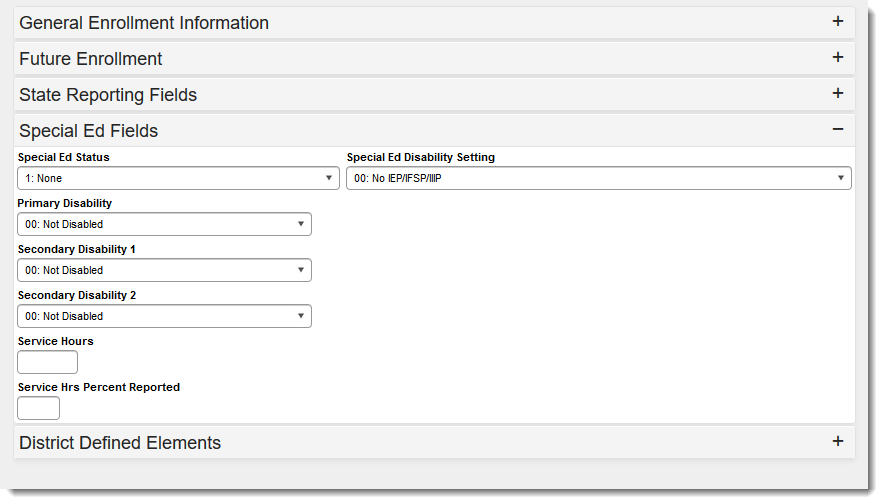 Special education fields vary by state.
Special education enrollment Ad hoc fields
Select fields in the Query Wizard from the Special Ed Elements folders in Student > Learner > Active Enrollment (activeEnrollment.XXX), All Enrollments (histEnrollment.XXX), folders, depending on what is needed in the report. Available fields vary by state.
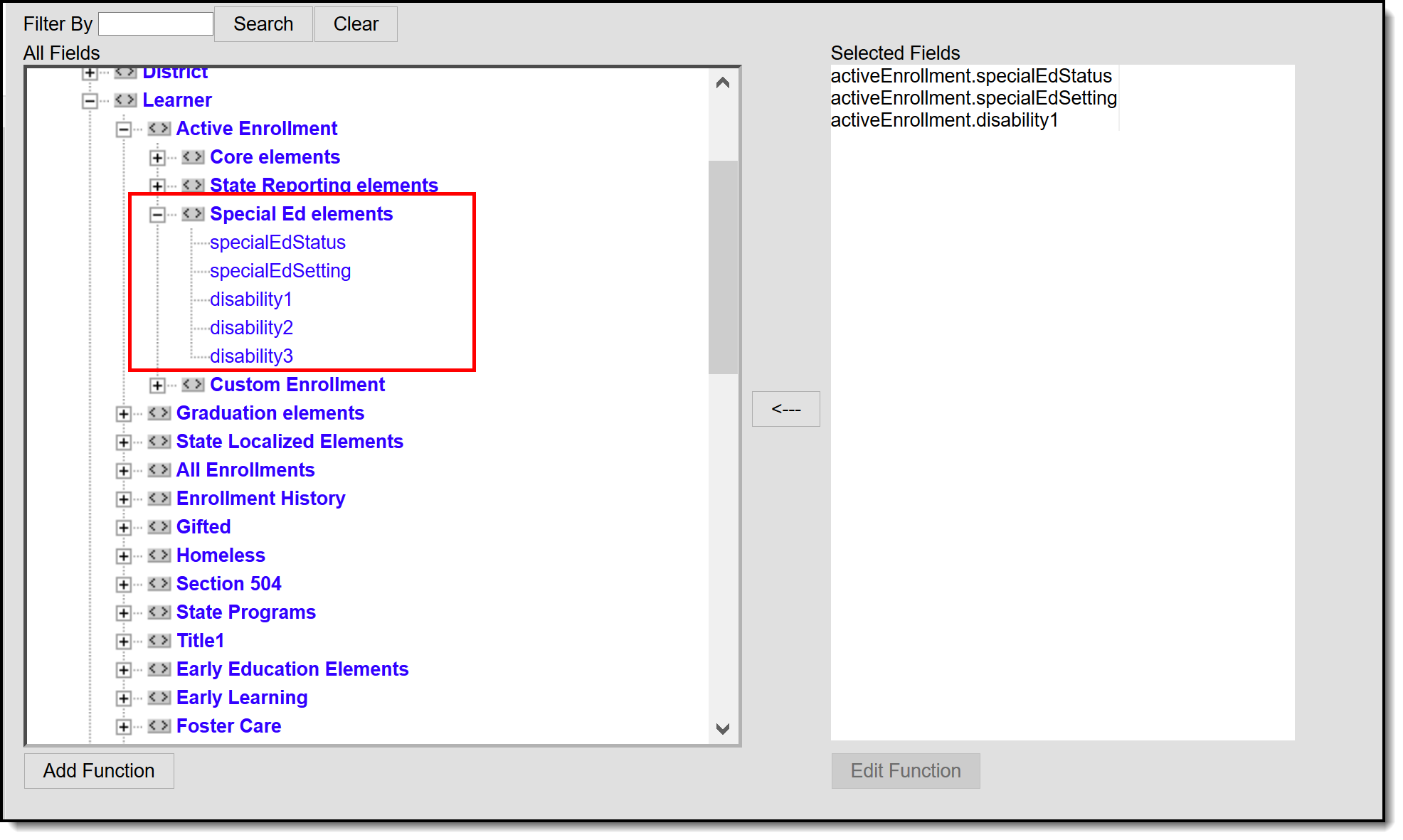 Special education fields can be included in Ad hoc filters to extract related data.
State-specific information
Fields vary by state. Follow these links to view enrollment information for your state. Linked articles open in a new browser tab.